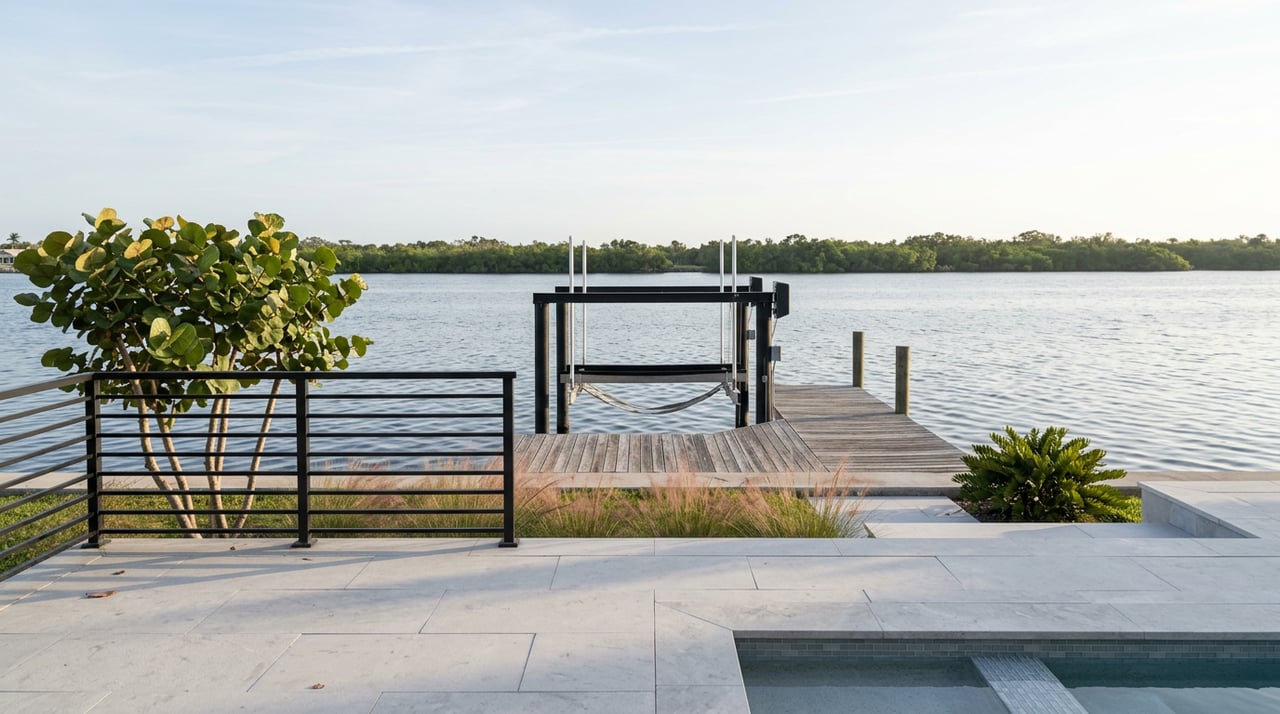
On Plantation Key, Two Homes on the Same Canal Can Have Completely Different Rental Rights
September 17, 2026
September 17, 2026
A buyer walks a canal-front home on Plantation Key, loves the dock, loves the sunset exposure, and asks the obvious question: can I rent this out by the week when I'm not here? The answer isn't in the listing sheet. It isn't in the square footage or the seawall condition. It's in a formula tied to the home's assessed value, a zoning designation that has nothing to do with how the house looks, and a license pool that has been effectively closed for years at a time.
Two houses a hundred feet apart, both on Plantation Key, both inside the same Village of Islamorada, can land on opposite sides of that formula. One can legally book a week at a time on any platform. The other cannot, no matter how much its owner wants it to. The line that decides this isn't the one separating Plantation Key from its neighbors. It's a line almost nobody draws on a map.
Plantation Key has been entirely inside the incorporated Village of Islamorada since November 4, 1997. Every parcel on the island, from the north end near Tavernier Creek to Snake Creek at the south end, falls under the Village's zoning code and building department, not Monroe County's. The Village's own boundary documents put its full jurisdiction at mile marker 90.939 down to mile marker 72.658, which covers the entire length of Plantation Key along with Windley Key and the Matecumbe keys further south.
That matters because Tavernier, the community immediately to the north across Tavernier Creek, is unincorporated Monroe County. Monroe County runs its own vacation rental program for unincorporated areas, with its own permit structure and its own default 28-day minimum stay. A buyer who assumes Plantation Key and Tavernier operate under one shared set of Keys rental rules is already working from the wrong rulebook. They're two different regulatory regimes separated by a bridge, and the rules that apply to a Plantation Key parcel are entirely the Village's, not the County's.
That's the boundary most people notice. It's also not the one that decides whether a specific house can rent weekly.
Islamorada's vacation rental ordinance sets a hard ceiling on how many properties in the entire Village can hold a license at any given time. According to the Islamorada Community Alliance's published analysis of the program, that ceiling sits at 331 licenses, village-wide, covering all six of Islamorada's islands, not just Plantation Key. There is no separate allotment carved out for any single key. A Plantation Key home competes for a slot against condos in Islamorada's mixed-use core and waterfront estates on Lower Matecumbe.
Getting one of those 331 slots requires clearing two more gates before the cap even comes into play. First, the property has to sit in a land use category the ordinance actually allows for vacation rental use, generally residential high density, mixed use, or residential low with a qualifying valuation. Plain residential-medium zoning, which covers a large share of ordinary single-family canal lots on Plantation Key, is not eligible for a new license under the current ordinance. Second, in the categories where a license is possible, the home has to meet a minimum assessed value tied to Monroe County income data. That threshold isn't fixed. It recalculates every year against 600 percent of the county's median household income, which is why a property that qualified two years ago can fall short today, or the reverse.
There's a narrow carve-out that predates all of this. When the Village significantly modified its vacation rental ordinance in 2006, it grandfathered a small group of existing rentals sitting in residential-medium zoning, the same category that's now closed to new licenses. The Islamorada Community Alliance's analysis puts that number at roughly 25 properties village-wide, still operating under their original approval nearly two decades later.
That's a genuinely small pool, and it isn't transferable in the sense a buyer might hope. A grandfathered license attaches to the specific approval on file for that parcel, not to a category of home a new owner can simply claim by purchase. Anyone counting on a "grandfathered" listing description to guarantee rental rights after closing needs the Village's confirmation in writing, not the seller's assurance.
Here's the friction that actually catches people off guard at the negotiating table. Islamorada's cap is a fixed number, but the Village doesn't maintain a public, real-time dashboard showing how many of the 331 slots are currently filled or open. Counts get published periodically, not continuously. A buyer relying on a listing description that says a home is "vacation rental eligible" is relying on someone's read of the ordinance at some point in the past, not a live confirmation that a slot exists today.
The only way to know for certain, before writing an offer that depends on rental income, is to call the Village's planning and building department directly and ask two questions: does this specific parcel's zoning and assessed value currently qualify, and is there an open slot in the license pool right now. Both answers can change between the day a listing goes live and the day a contract closes.
This is where the mechanism stops being a regulatory footnote and starts being a pricing question. A Plantation Key canal home's list price is built from comparable sales, square footage, dock length, and canal depth. None of the public comps distinguish between a house that can legally book weekly and one that's locked into a 28-day-or-longer stay under Village rules, because that distinction doesn't show up in any MLS field.
For a buyer whose plan includes rental income, that gap is the whole ballgame. Two homes priced within a few percentage points of each other on paper can carry very different realistic income ceilings once one of them turns out to sit in residential-medium zoning with no path to a license and the other qualifies outright. The premium for a confirmed, transferable vacation rental license isn't listed anywhere. It has to be verified, parcel by parcel, before it can be priced into an offer.
If rental income is part of the plan for a Plantation Key purchase, a few things are worth confirming before, not after, a contract goes hard:
None of this is complicated, but it does require a phone call most buyers don't think to make until after they've fallen in love with a dock.
Does a vacation rental license automatically transfer when a Plantation Key home sells? Not automatically. Licenses are tied to Village approval for that specific parcel and use, so a buyer typically needs to confirm the license's status with the Village and, in most cases, reapply or have the transfer processed as part of closing rather than assuming continuity.
If Plantation Key is full but Tavernier next door isn't, can I just buy there instead for easier rental rights? Tavernier operates under Monroe County's own program, with a default 28-day minimum stay and its own permit process, which is a different set of restrictions rather than a looser one. It solves a jurisdictional question, not necessarily a rental-flexibility one.
Is the assessed value threshold the same across all of Plantation Key? No. The ordinance sets different valuation floors depending on the underlying land use category, so a home in one zoning designation can face a different dollar threshold than a home just down the street in another.
Plantation Key rewards buyers who ask the right questions in the right order, and the rental license question belongs near the top of that list, not somewhere after the home inspection. If you're weighing a canal-front purchase here against income potential, or you already own one and want to know exactly where your property sits relative to the Village's current thresholds, Sally Stribling Luxury Group works this ground every day and can help you get a straight answer before you're under contract. Let's Connect.
Stay up to date on the latest real estate trends.

We pride ourselves in providing personalized solutions that bring our clients closer to their dream properties and enhance their long-term wealth. Contact us today to find out how we can be of assistance to you!