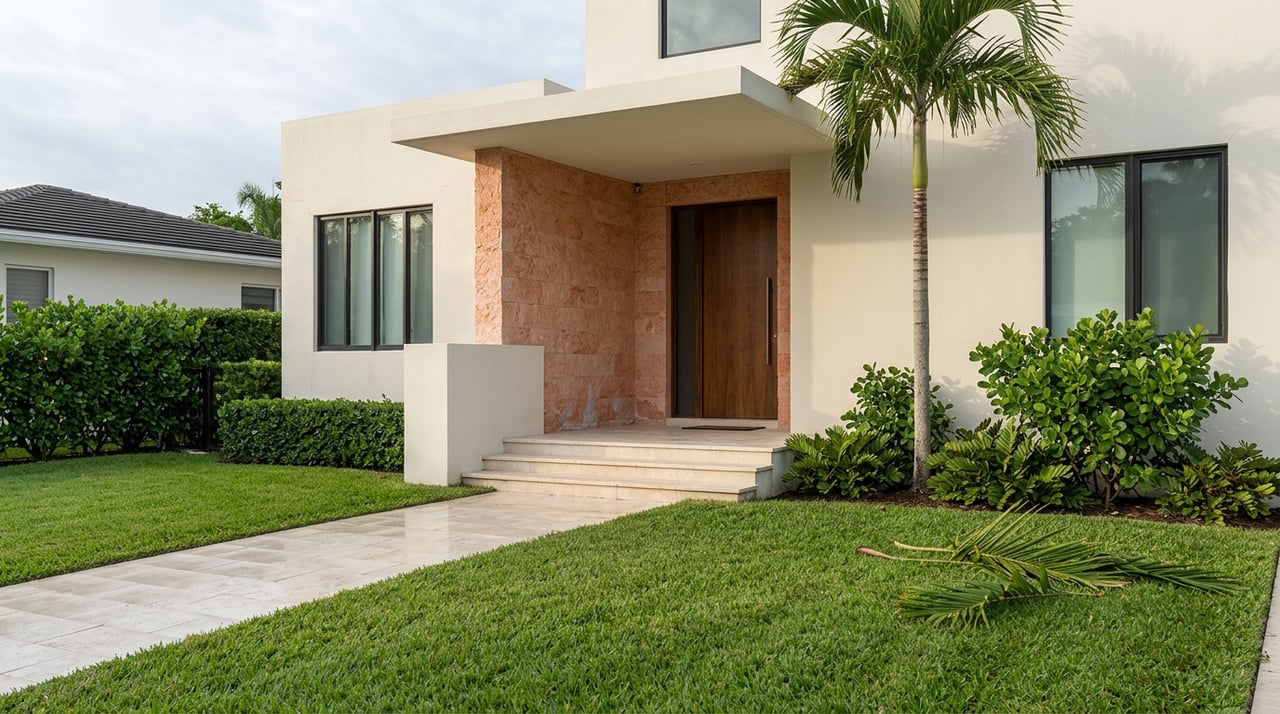
In Islamorada, You're Not Buying the Lot. You're Buying Its Place in Line.
September 3, 2026
September 3, 2026
Two vacant parcels can sit on the same street in Islamorada, same square footage, same zoning, same view of the same canal, and list for very different prices. Buyers who compare them side by side usually assume the gap comes down to elevation, or soil, or some quiet flaw one seller is hiding. Sometimes that's true. More often, the real difference has nothing to do with the dirt at all. It has to do with whether that lot already holds a building permit allocation, whether it qualifies for an exemption because a house once stood there, or whether it's sitting in a scored, capped queue waiting for a permit that may not arrive for years.
That queue is real, it has a name, and it has been rewritten twice in the past two years. If you're shopping vacant land in Islamorada right now, understanding where a specific lot sits in that system will tell you more about its true value than any comparison to the median sale price ever will.
A "buildable" lot in Islamorada isn't a fixed description of the land. It's a temporary regulatory status, and that status can expire, get bumped in line, or skip the line entirely depending on what happened on that parcel before.
Islamorada runs its own permit system, separate from unincorporated Monroe County's better-known Rate of Growth Ordinance. The village's version is called the Building Permit Allocation System, or BPAS, and it exists for the same reason ROGO does everywhere else in the Keys: state law requires that the permanent population be able to evacuate ahead of a hurricane within a set clearance window, and the number of new residential permits issued each year is capped and scored to keep pace with that requirement.
What that means in practice is that a vacant, residentially zoned lot in the village can be in one of three states, and each one behaves like a different asset.
| Status | What it means | Typical path to a permit | What drives the price |
|---|---|---|---|
| Active allocation in hand | The lot already won a spot in a past BPAS cycle | Ready to permit now, pending plans and inspections | Commands a premium because the wait is already over |
| Exempt (prior structure) | A home or other structure previously stood on the parcel | Owner documents the prior structure and rebuilds without entering the scoring queue | Priced closer to a comparable built lot, since there's no allocation risk |
| Unallocated, scored | No prior structure, no allocation yet | Enters the competitive BPAS queue and waits for a future cycle | Discounted for uncertainty, sometimes heavily, depending on where it ranks |
The first two categories are, for practical purposes, ready to build. The third is a bet on a process that has been anything but predictable.
Of the 3,550 ROGO permits the state authorized for the entire Keys through July 2023, only 280 were ever allocated to Islamorada specifically, issued at a rate of about 28 a year. That original pool ran dry at a November 2022 village council meeting, when the outgoing council approved a schedule to hand out its last remaining permits and the incoming council was left with none to allocate.
The village spent the next two years figuring out what came next. Staff analysis presented to the council in late 2024 identified 178 vacant parcels in Islamorada that met the basic criteria for a residential permit: correctly zoned, meeting minimum lot size, and recorded as vacant by the property appraiser as of 2022, on top of 54 applicants already waiting for a permit under the old, exhausted pool. The planning department recommended requesting 250 new allocations from the state to clear that backlog at a reasonable pace. The outgoing council, in one of its final votes, settled on a smaller number instead: 104.75 new allocations, phased in across roughly twelve and a half years, a rate slower even than the original 28-a-year pace. A newly elected councilman asked the incoming council to reconsider that number soon after.
That same fall, Monroe County commissioners had separately asked the state for 220 additional allocations across the Keys, with 40 of those slated for Islamorada specifically, a request that ran in parallel to the village's own ask and added another layer to an already complicated picture. Ann Olsen, president of the local conservation group Last Stand, told the council that a county survey found 84 percent of residents wanted either no new permits at all or no more than that 220-allocation request. Council discussion at the same meeting cited strains on Islamorada's infrastructure, including a failing level of service on U.S. 1 and a sewer system that had experienced eight major pipe breaks, as reasons to move slowly. That local appetite for caution is part of why the outgoing council chose a smaller number than the planning department's recommendation. The queue isn't just capped by state formula. It's capped by what residents are willing to approve.
Before the village and county could fully sort out their own separate requests, the Florida Legislature passed Senate Bill 180 in 2025, authorizing up to 900 new building permit allocations across the entire island chain, to be distributed over a period of at least ten years. In exchange, the state agreed to stretch the mandated hurricane evacuation clearance time from 24 hours to 24.5 hours, the technical trade that makes the additional permits legally possible in the first place.
Those 900 allocations aren't handed out as one pool. Each jurisdiction's share depends on how many vacant, buildable lots it has, and Monroe County alone expects to eventually receive around 588 of the 900, with staff drafting language to distribute that share at roughly 40 allocations a year once state sign-off is complete. The balance is split among the incorporated municipalities, Islamorada included, based on the same vacant-lot count method.
Heading into a December 17, 2025 meeting, where Governor Ron DeSantis and the Cabinet were set to convene as the Administration Commission and were expected to approve the 900 statewide allocations, county planning staff had already recommended a bridge: earmarking 62 of the county's existing "administrative relief" allocations to keep permits flowing through July 2027 while the larger SB 180 rollout got sorted out with the Florida Department of Commerce. Monroe County's own growth management office has since confirmed that those implementing amendments are still moving through the public hearing process, and it does not expect the next full ROGO allocation period to open until July 13, 2027.
Islamorada's own BPAS office, meanwhile, has kept processing the village's separate 2024 allocation in small quarterly batches, with approved rankings posted for 2025's fourth quarter and 2026's first and second quarters, and a draft ranking already circulating for the third quarter of 2026. That's the village working through its own 104.75 allocations, a much smaller and separately timed stream than the still-unresolved SB 180 pool.
Translate that into buyer terms: if you're counting on the SB 180 allocations to loosen up the vacant-lot market soon, the timeline runs in years, not months, and whatever lots eventually get an allocation will still be scored the same competitive way the old ones were.
None of that timeline touches a lot that's already exempt. Monroe County's land development code defines a category of parcels as lawfully established for a ROGO or BPAS exemption, meaning a dwelling unit or structure previously received a permit or official approval on that site. In practice, this covers a home that was torn down, whether by choice or after storm damage, where the owner can document that a prior structure existed. That documentation lets an owner rebuild without ever entering the competitive scoring process that a true vacant-lot buyer has to join.
This is the detail that explains why two lots that look identical from the street curb can carry very different price tags and very different levels of buyer confidence. A lot with a documented prior structure is, for permitting purposes, functionally equivalent to a lot with an active allocation already in hand. A lot that was always vacant, with no structure in its history, has to compete for whatever trickle of new allocations the village or county releases next.
Before making an offer on any vacant parcel in Islamorada, a few questions matter more than the listing photos or the asking price:
A seller's asking price for a vacant lot is a claim about the future. The BPAS status is the evidence for or against that claim.
A median price for vacant land in Islamorada averages together lots that are ready to build tomorrow with lots that may wait a decade for a permit that isn't guaranteed to arrive. That's not a market inefficiency. It's the system working exactly as designed, trading a slower, scored release of new permits for a hurricane evacuation clearance time the state is willing to sign off on. For a buyer, the practical takeaway isn't that vacant land in Islamorada is risky in some vague sense. It's that the risk is specific, documented, and checkable, and it lives in the BPAS record for that exact parcel, not in the comparable sales down the street.
If you're weighing a vacant lot against a comparable built home in Islamorada, or trying to make sense of why two similar parcels are priced so differently, Sally Stribling Luxury Group can walk through the specific BPAS and exemption status of any property you're considering before you make an offer. Let's Connect.
Stay up to date on the latest real estate trends.

We pride ourselves in providing personalized solutions that bring our clients closer to their dream properties and enhance their long-term wealth. Contact us today to find out how we can be of assistance to you!