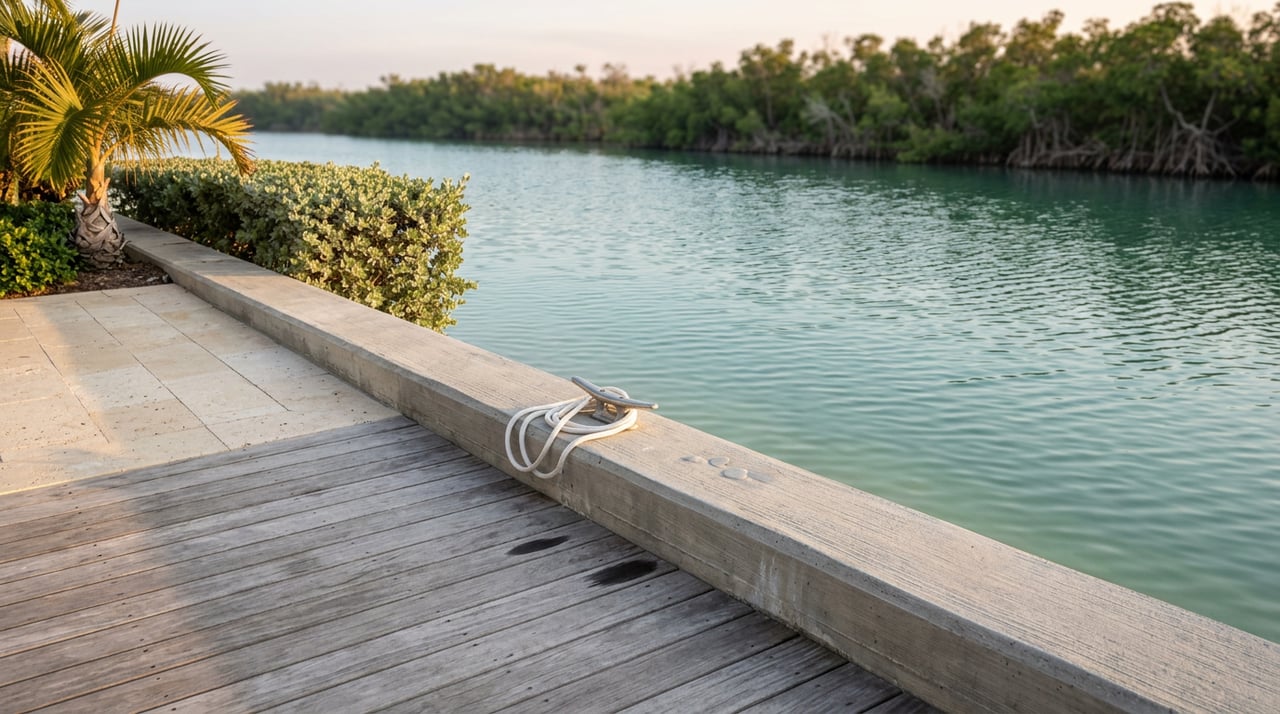
Bayside or Oceanside in Key Largo? You're Asking the Wrong First Question
August 13, 2026
August 13, 2026
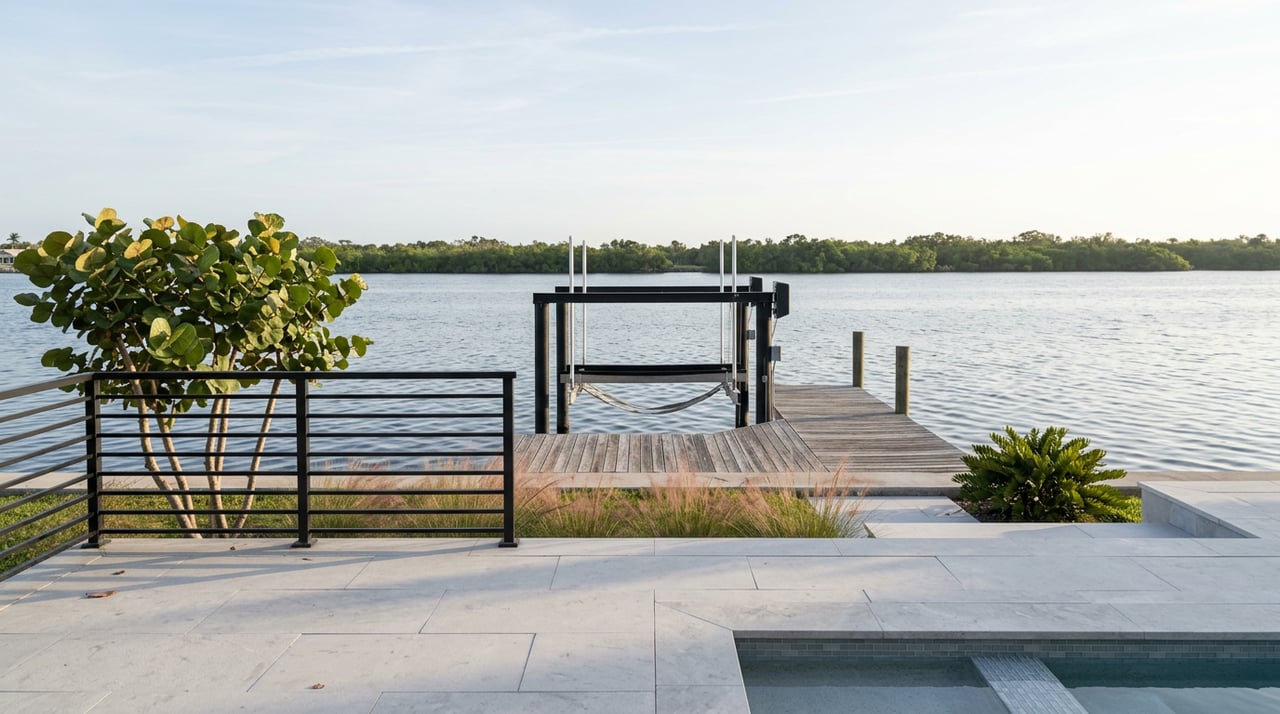
A Port Largo listing that came to market in May 2026 described itself as an oceanside property with fifty feet of dockage, a boat lift, and jet ski davits, then noted in the same breath that bayside water was reachable too, through South Creek near John Pennekamp Coral Reef State Park and the Marvin Adams Waterway. One address. Both sides of the island.
That listing was not an anomaly. It was a preview of the actual decision buyers face in Key Largo, and it is not the one most of them think they are making.
Before we get to canals and channels, here is the friction point that catches people off guard after they have already picked a side. Monroe County requires a 28-day minimum rental period on residential properties, and that rule applies regardless of whether the home sits oceanside, bayside, or on a canal that splits the difference. It is a county requirement, not a homeowners association preference, which means it travels with the property no matter which subdivision you choose.
Buyers who assume oceanside means more rental flexibility, or that a quieter bayside canal comes with looser short-term rules, are solving a problem that does not exist. If income potential is part of your calculation, the 28-day floor is the same conversation everywhere in Key Largo. What changes is not the rule. It's what the property can actually do for you day to day, and that has almost nothing to do with which coastline the sun sets over.
As of June 2026, the average home value across Key Largo sat at $1,095,644, up 2.0% over the prior year. Keys-wide, the median sale price for residential properties reached $965,000 in May 2026, up 12% from a year earlier, with active inventory essentially flat and closed sales up 15% over the same period.
Those numbers describe a market moving fast on tight supply. What they don't describe is what you'd actually be buying at that price, because Key Largo's waterfront inventory spans everything from modest canal homes to gated oceanfront compounds with private marinas. Averaging those together produces a number that fits none of them. Ocean Reef Club, the private gated community at the island's north end with its own marina, airport, and golf course, operates in a price tier separate from the rest of the market entirely. A single citywide average papers over that gap, and over dozens of smaller ones like it.
Key Largo's waterfront breaks down into oceanside, bayside, and canalfront categories, but the boating and lifestyle characteristics shift block by block within each one, not neatly along the ocean-bay line.
Port Largo sits near Mile Marker 100 as an established oceanside boating neighborhood, built out in concrete block construction with canals that run wider than most others in Key Largo, which matters more to a sportfish captain than any marketing photo ever could. Its oceanside access to the reef and open Atlantic is direct. Its bayside access exists too, through that same South Creek and Marvin Adams Waterway route.
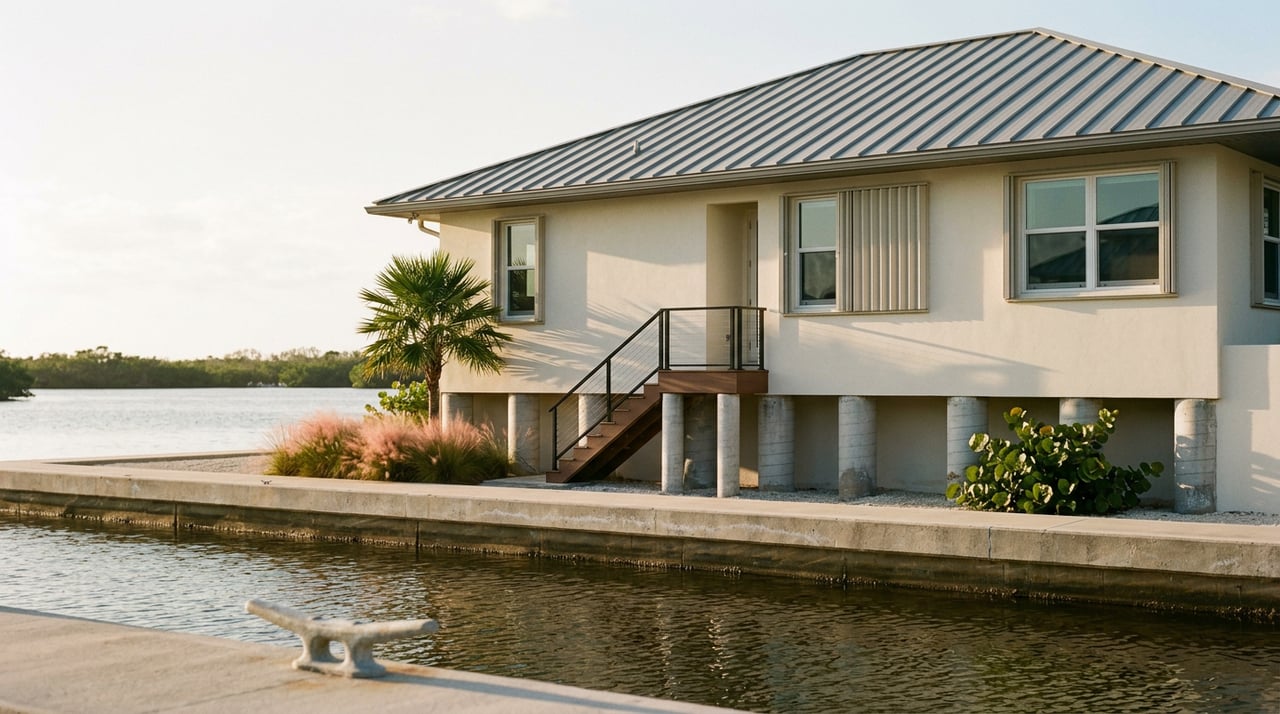
A few miles away, Key Largo Ocean Resort occupies a gated, private stretch of oceanfront at Mile Marker 94.8. Its 285 individually owned parcels include a growing share of elevated concrete homes built to current code, and residents reach the Atlantic through an on-site marina with a private ramp, alongside a pool, tennis court, fitness center, and staffed entry. It is oceanside in every technical sense, but it functions more like a resort community than a boating enclave.
Then there's the Largo Sound area, where properties mix canalfront and bay access in the same stretch of neighborhood, and communities like Twin Lakes and Hammer Point, which layer lake and canal characteristics into what would otherwise get filed simply as "waterfront." None of these fit cleanly into a two-column oceanside-versus-bayside comparison, because the real variation happens inside each community, not between them.
The question that actually predicts how a Key Largo waterfront property will perform isn't which side of the island it's on. It's what the specific canal, channel, or shoreline in front of it can physically support.
Here is the mechanism underneath all of it. Two homes on the same side of Key Largo, in the same subdivision, can have completely different boating functionality depending on four things: channel depth at mean low water, your boat's actual draft, the clearance under any fixed bridges between the dock and open water, and the permitted length of the dock and lift itself.
A canal can look wide and inviting and still be too shallow at low tide for anything beyond a center console. A property advertised as having direct ocean access might route through a bridge with a clearance that rules out a boat with a taller tower. None of this shows up in a listing photo, and very little of it shows up in the ocean-or-bay label that most buyers use to sort their search.
You can check a lot of this yourself before you ever schedule a showing. NOAA's nautical charts show channel depths and marked routes for the surrounding waters, and they're worth reviewing against your boat's draft before you fall for a dock. Flood zone designation adds another layer that tracks with construction and insurance cost more than with which coastline you chose. Oceanfront parcels in Key Largo often fall into V or VE flood zones, which account for direct wave action, while canalfront homes may land in AE or VE zones depending on elevation and how FEMA models that specific stretch of shoreline. You can look up a property's designation directly through the FEMA Flood Map Service Center before you're deep into a contract.
Ask people who have owned on both sides for years and you'll hear things that never make it into a listing description. Bayside owners tend to mention more insects on calm evenings, a side effect of the prevailing trade winds. Oceanside owners point to more direct exposure during major storms, and longtime residents who lived through Hurricane Irma in 2017 have described oceanside properties in some pockets taking harder hits than bayside homes just a few streets over. These are the kinds of observations that come from having actually lived somewhere through a hurricane season, not from a spec sheet, and they matter more for day-to-day comfort than the postcard difference between turquoise reef water and a protected sunset anchorage.
Given all of this, the ocean-or-bay question is worth asking, but it should never be the only one on your list. Before you make an offer on Key Largo waterfront, confirm:
Does buying oceanside guarantee better resale value than bayside in Key Largo? Not on its own. Some of the most sought-after luxury properties in the Keys sit bayside because of sunset exposure and protected dockage, while others command a premium oceanside for direct reef access. Construction quality, canal characteristics, and redevelopment potential tend to drive long-term value more than the side of the island alone.
Is the 28-day rental minimum different depending on which side I buy? No. It's a Monroe County requirement that applies to residential rentals island-wide, independent of oceanside, bayside, or canalfront location. If a listing implies otherwise, that's worth confirming directly before you rely on it.
How do I check a canal's real depth before making an offer? Start with NOAA's nautical charts for the surrounding waters, then ask the seller for recent soundings or any dredging records. A canal that reads as deep enough on paper can still surprise you at low tide if no one has verified it recently.
The side of the island you buy on will shape your view and your commute to open water. It will not, by itself, tell you whether your boat fits under the bridge, whether your dock can legally hold the lift you want, or whether your flood insurance premium reflects a V zone or an AE zone. Those answers live in the specific parcel, not the general direction it faces, and that is exactly the kind of block-by-block detail that a local search filter can't surface but a local broker can.
If you're comparing Key Largo waterfront properties and want someone who can walk a canal's history, not just its listing photos, Sally Stribling has spent decades on this stretch of the Upper Keys. Let's Connect and talk through what a specific address can actually support before you make it yours.
Stay up to date on the latest real estate trends.

We pride ourselves in providing personalized solutions that bring our clients closer to their dream properties and enhance their long-term wealth. Contact us today to find out how we can be of assistance to you!